• Mar 08, 2026

Urban Food Index- March 6th Update

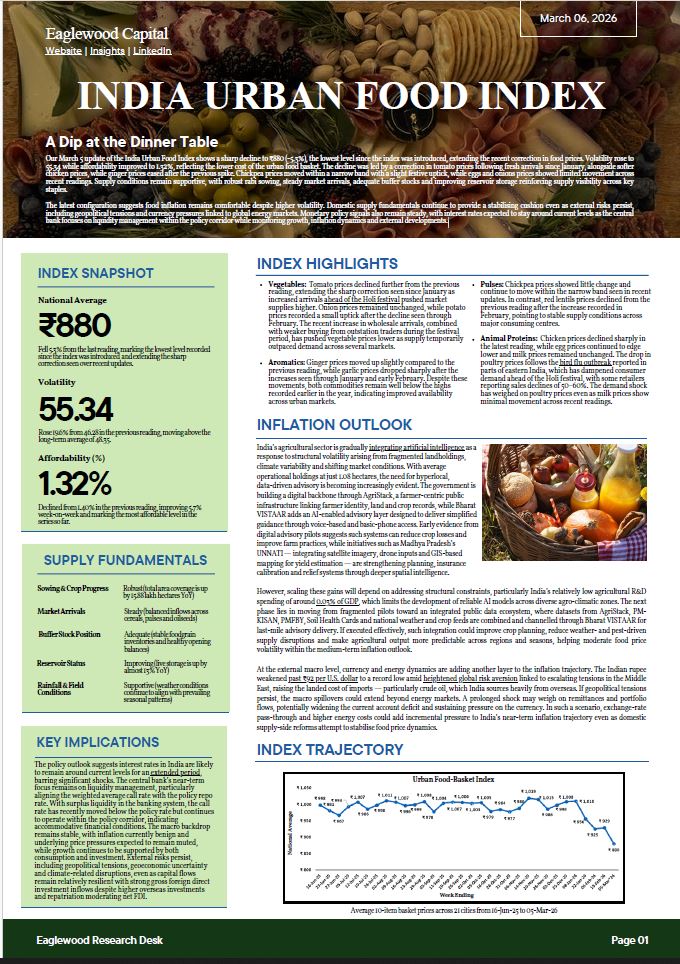
Our March 5 update of the India Urban Food Index shows a sharp decline to ₹880 (-5.3%), the lowest level since the index was introduced, extending the recent correction in food prices. Volatility rose to 55.34 while affordability improved to 1.32%, reflecting the lower cost of the urban food basket. The decline was led by a correction in tomato prices following fresh arrivals since January, alongside softer chicken prices, while ginger prices eased after the previous spike. Chickpea prices moved within a narrow band with a slight festive uptick, while eggs and onions prices showed limited movement across recent readings.Supply conditions remain supportive, with robust rabi sowing, steady market arrivals, adequate buffer stocks and improving reservoir storage reinforcing supply visibility across key staples. The latest configuration suggests food inflation remains comfortable despite higher volatility. Domestic supply fundamentals continue to provide a stabilising cushion even as external risks persist, including geopolitical tensions and currency pressures linked to global energy markets. Monetary policy signals also remain steady, with interest rates expected to stay around current levels as the central bank focuses on liquidity management within the policy corridor while monitoring growth, inflation dynamics and external developments.
  • Mar 08, 2026

Urban Food Index- Feb 20th Update

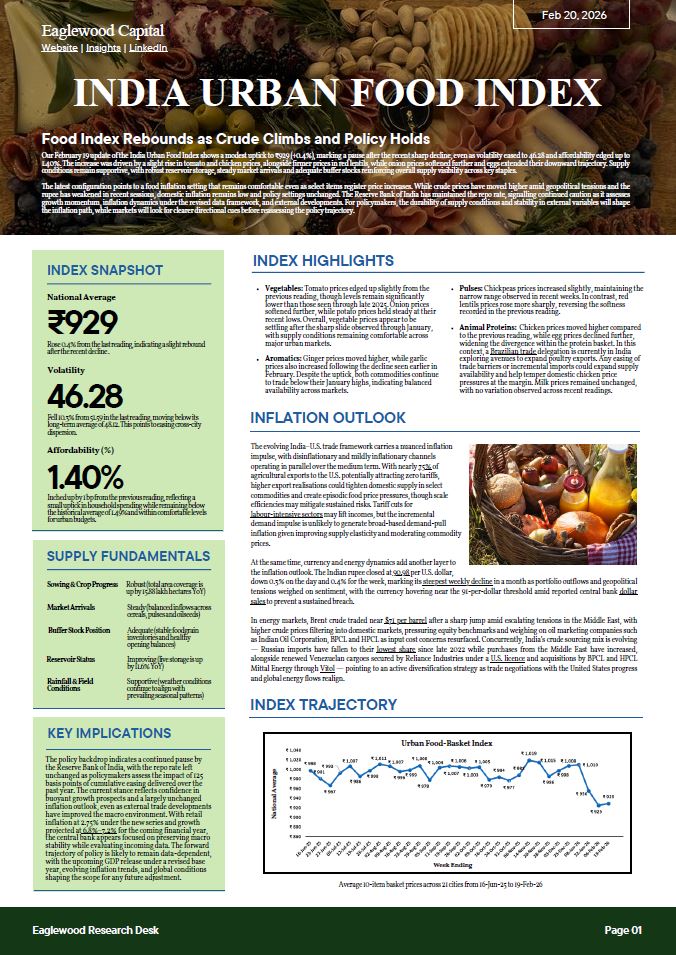
Our February 19 update of the India Urban Food Index shows a modest uptick to ₹929 (+0.4%), marking a pause after the recent sharp decline, even as volatility eased to 46.28 and affordability edged up to 1.40%. The increase was driven by a slight rise in tomato and chicken prices, alongside firmer prices in red lentils, while onion prices softened further and eggs extended their downward trajectory. Supply conditions remain supportive, with robust reservoir storage, steady market arrivals and adequate buffer stocks reinforcing overall supply visibility across key staples. The latest configuration points to a food inflation setting that remains comfortable even as select items register price increases. While crude prices have moved higher amid geopolitical tensions and the rupee has weakened in recent sessions, domestic inflation remains low and policy settings unchanged. The Reserve Bank of India has maintained the repo rate, signalling continued caution as it assesses growth momentum, inflation dynamics under the revised data framework, and external developments. For policymakers, the durability of supply conditions and stability in external variables will shape the inflation path, while markets will look for clearer directional cues before reassessing the policy trajectory.

  • Feb 17, 2026

Urban Food Index- Feb 7th Update

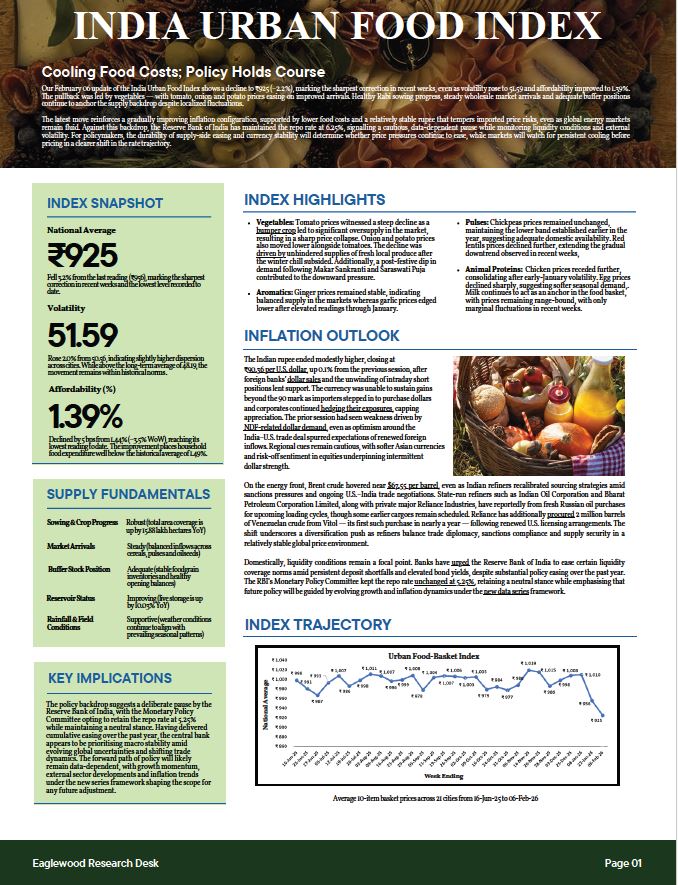
Our India Urban Food Index shows a decline to ₹925 (–2.2%), marking the sharpest correction in recent weeks, even as volatility rose to 51.59 and affordability improved to 1.39%. The pullback was led by vegetables — with tomato, onion and potato prices easing on improved arrivals. Healthy Rabi sowing progress, steady wholesale market arrivals and adequate buffer positions continue to anchor the supply backdrop despite localized fluctuations.The latest move reinforces a gradually improving inflation configuration, supported by lower food costs and a relatively stable rupee that tempers imported price risks, even as global energy markets remain fluid. Against this backdrop, the Reserve Bank of India has maintained the repo rate at 6.25%, signalling a cautious, data-dependent pause while monitoring liquidity conditions and external volatility. For policymakers, the durability of supply-side easing and currency stability will determine whether price pressures continue to ease, while markets will watch for persistent cooling before pricing in a clearer shift in the rate trajectory.

  • Feb 17, 2026

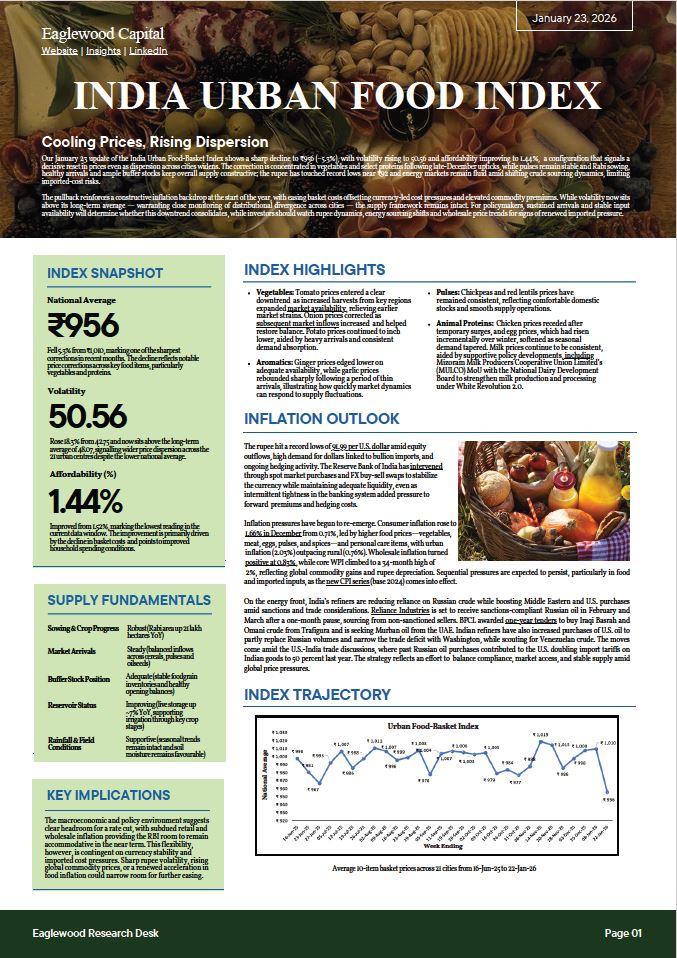
Urban Food Index- Jan 23rd Update

Our January 23 update of the India Urban Food-Basket Index shows a sharp decline to ₹956 (–5.3%), with volatility rising to 50.56 and affordability improving to 1.44%, a configuration that signals a decisive reset in prices even as dispersion across cities widens. The correction is concentrated in vegetables and select proteins following late-December upticks, while pulses remain stable and Rabi sowing, healthy arrivals and ample buffer stocks keep overall supply constructive; the rupee has touched record lows near ₹92 and energy markets remain fluid amid shifting crude sourcing dynamics, limiting imported-cost risks.The pullback reinforces a constructive inflation backdrop at the start of the year, with easing basket costs offsetting currency-led cost pressures and elevated commodity premiums. While volatility now sits above its long-term average — warranting close monitoring of distributional divergence across cities — the supply framework remains intact. For policymakers, sustained arrivals and stable input availability will determine whether this downtrend consolidates, while investors should watch rupee dynamics, energy sourcing shifts and wholesale price trends for signs of renewed imported pressure.

  • Feb 17, 2026

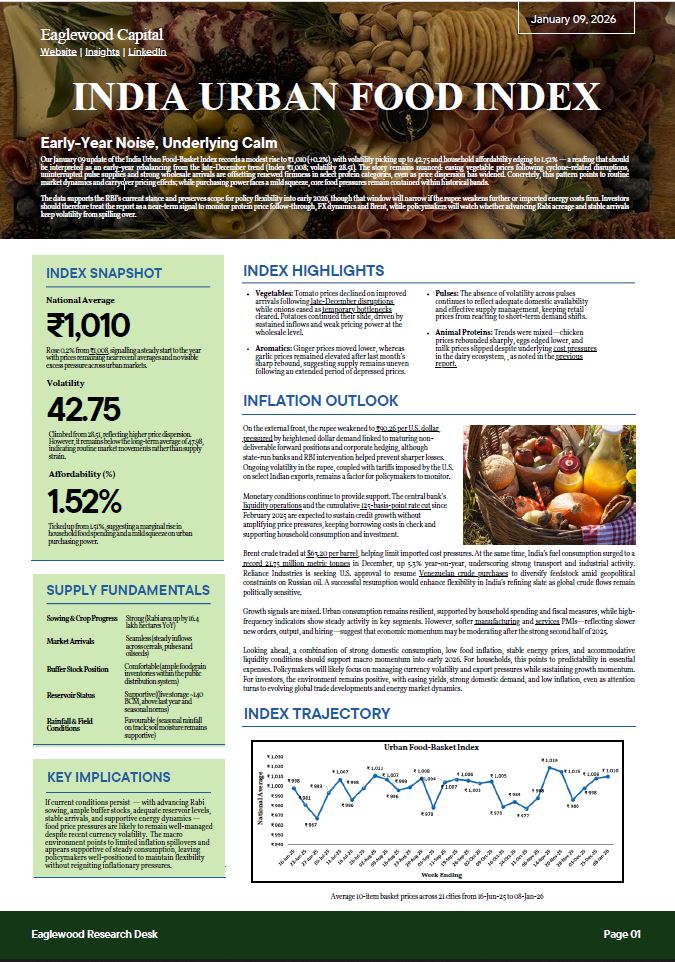
Urban Food Index- Jan 9th Update

Our January 09 update of the India Urban Food-Basket Index records a modest rise to ₹1,010 (+0.2%), with volatility picking up to 42.75 and household affordability edging to 1.52% — a reading that should be interpreted as an early-year rebalancing from the late-December trend (Index ₹1,008; volatility 28.51). This pattern points to routine market dynamics and carryover pricing effects; while purchasing power faces a mild squeeze, core food pressures remain contained within historical bands. The data supports the RBI’s current stance and preserves scope for policy flexibility into early 2026, though that window will narrow if the rupee weakens further or imported energy costs firm. Investors should therefore treat the report as a near-term signal to monitor protein price follow-through, FX dynamics and Brent, while policymakers will watch whether advancing Rabi acreage and stable arrivals keep volatility from spilling over.

  • Dec 31, 2025

Urban Food Index - Policy Room Intact

Our December 26 update of the India Urban Food‑Basket Index records a modest rise to ₹1,008 (+1.0%), with volatility easing to 28.51 and household affordability steady at 1.51% — a reading that should be read alongside the 21 November snapshot (Index ₹1,015; volatility 32.64) rather than as a simple week‑on‑week continuation. The story is consistent: recent headline noise is concentrated in high‑velocity vegetables — Cyclone Ditwah has tightened Andhra Pradesh tomato supplies and could push retail prices toward ₹100/kg in affected states — while staples, pulses and proteins remain broadly stable and buffer stocks are ample. Concretely, this pattern points to a seasonal, localized wobble rather than a broad inflation turn; household purchasing power and core pressures remain subdued.The data supports the RBI’s current stance and preserve scope for gradual, calibrated easing into early 2026, but that window will narrow quickly if the rupee weakens further or imported energy costs spike. Investors should therefore treat the report as a near‑term signal to monitor vegetable arrivals, FX dynamics and Brent, and policymakers should watch whether winter arrivals broaden supply and volatility stays low. Read the full report for city‑level maps, volatility trends and our scenario checklist that will determine whether this seasonal shock fades or consolidates.

  • Dec 30, 2025

Urban Food Index-Disinflation Holds

Our November 21 update of the India Urban Food‑Basket Index finds the basket at ₹1,015 (-0.4% w/w) with volatility down to 32.64, a pattern that confirms last week’s view: a short‑lived, concentrated weather shock in high‑velocity vegetables rather than a broad inflation turn. Tomatoes remain the outlier — retail jumps of 25–100% in some states have driven headline noise even as Rabi sowing, healthy wholesale arrivals and ample buffer stocks keep overall supply constructive; Brent sits near the low‑$60s and the rupee has weakened to about ₹89.6, raising imported‑cost and FX risks.The implication for inflation is straightforward: household affordability and core pressures remain subdued, so this episode is more a seasonal wobble than a regime change. For monetary policy, the data support the RBI’s measured pause and preserve scope for gradual, calibrated easing, but that window will narrow quickly if the rupee weakens further or energy prices spike. Investors should treat the report as a near‑term signal to monitor vegetable arrivals, FX dynamics and Brent; policymakers should watch whether winter arrivals broaden supply and volatility stays low. Read the full report for city‑level maps, volatility trends and our scenario checklist that will determine whether this uptick fades or consolidates.

  • Dec 30, 2025

Urban Food Index- Inflation Anchored

This report, dated 15 November 2025, shows the India Urban Food‑Basket Index at ₹1,019 (+3.1% w/w) with volatility collapsing to 38.25, a pattern that signals a selective, seasonal uptick rather than broad‑based inflationary pressure and directly reinforces the assessment in our 7 November note. Supply indicators remain constructive — Rabi sowing ahead of last year, healthy wholesale arrivals, comfortable buffer stocks and reservoirs — while energy costs sit near Brent ~$65 and the rupee trades around ₹88.50, creating a backdrop in which headline food prices can spike briefly without triggering sustained pass‑through to core inflation.For policy, the practical implication is clear: the data support the RBI’s measured pause and preserve scope for gradual, calibrated easing only if external risks (FX volatility, imported energy shocks, or trade disruptions) do not intensify; a persistent rupee weakening or a jump in Brent would narrow that window. Investors should treat this as a near‑term signal to monitor vegetable arrivals, rupee dynamics and Brent rather than as evidence of a renewed inflation cycle; policymakers should watch whether winter arrivals broaden supply and whether volatility remains subdued. Read the full report for city‑level price maps, volatility trends and our scenario checklist that will determine whether this uptick fades or consolidates.

  • Nov 27, 2025

Urban Food Index- Ebbing Price Pressures, Policy Pause Intact

For the week ending Nov 7th, our India Urban Food‑Basket Index rose to ₹988 (+1.1% w/w), a contained seasonal rebound driven by early‑winter supply transitions rather than a broad inflation shock. Strong Kharif output, active post‑harvest arrivals, near‑full reservoirs and softer global energy costs remain the key forces keeping retail food inflation subdued, reinforcing last week’s narrative that relief is broad‑based across perishables, pulses and proteins. Volatility has ticked up, while household affordability is within comfortable ranges, implying limited near‑term pass‑through to headline CPI.For the Reserve Bank, these readings strengthen the case for a continued policy pause; if disinflation persists through the Rabi transition, optionality for a calibrated easing early next year increases, but imported‑cost channels — a mildly softer rupee, shifting edible‑oil and crude trade flows, and large bullion imports — remain credible tail risks that could delay or temper any easing.

  • Nov 06, 2025

Urban Food Index-Softening Grocery Costs, Steady Rate Outlook

Our national 10‑item basket eased to ₹977 (‑0.7% w/w) as the post‑monsoon harvest cycle restores steady arrivals; at the same time volatility ticked higher even as household affordability remained high. Strong supply buffers — healthy Kharif output, robust market inflows, near‑full reservoirs and softer global energy costs are the concrete forces behind this moderation, creating measurable downward pressure on retail food inflation. Compared with our previous note, the latest print reinforces a stabilisation narrative: the relief is broad‑based across perishables, pulses and proteins rather than concentrated in a few cities.For inflation and the RBI, current readings bolster the near‑term case for a policy pause while preserving optionality for a calibrated easing early next year if disinflation persists; imported cost risks — a mildly softer rupee, shifting edible‑oil and crude trade flows, and large bullion imports — remain credible tail risks that could delay or temper any easing.